Best Backup Power Solutions for Home
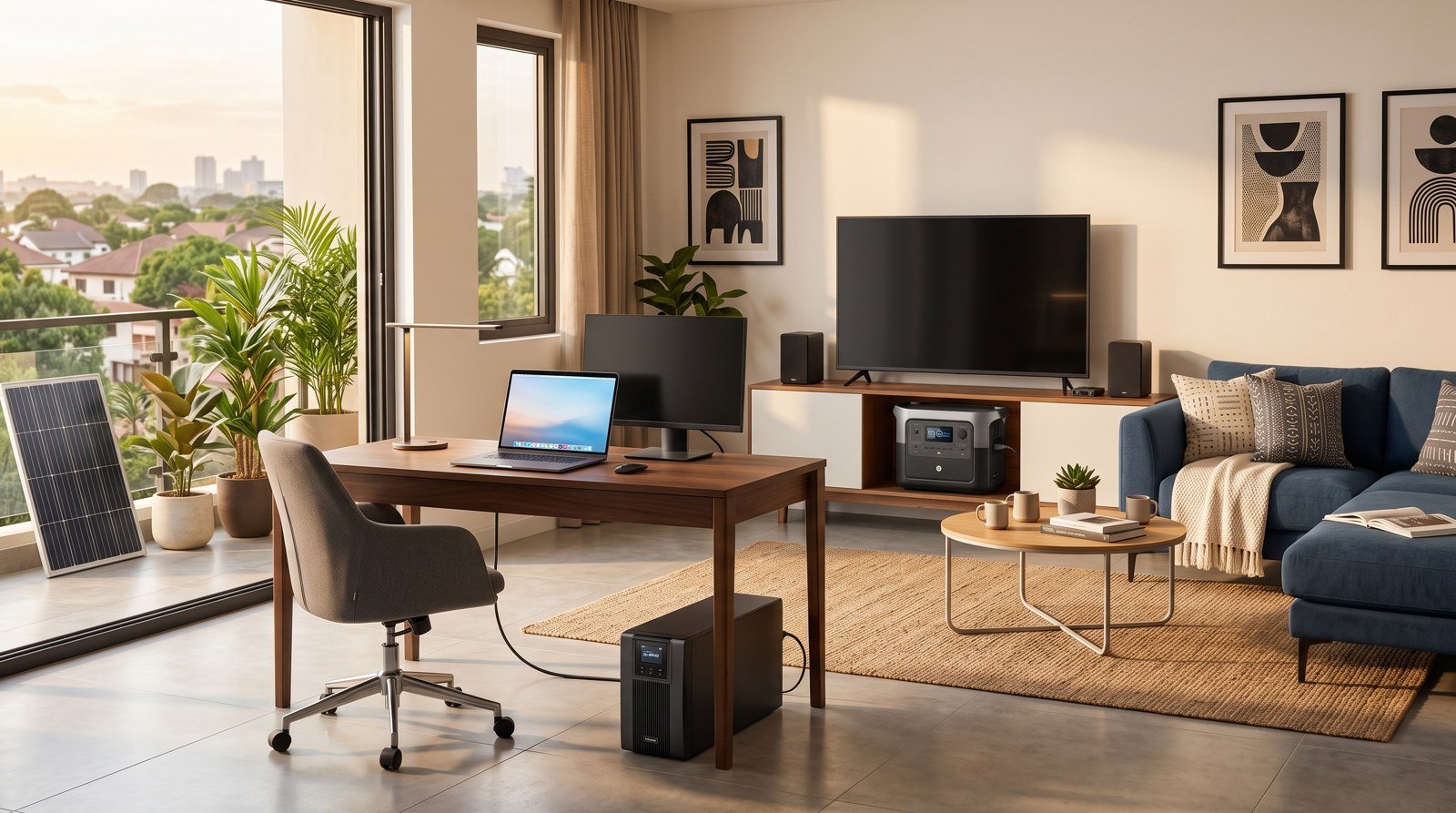
When power cuts strike — unpredictably, frequently, and without warning — your router goes silent, your children’s tablets dim, your fridge stops humming, and your evening TV ritual dissolves into candlelight. Across Africa, best backup power solutions for home aren’t luxury extras. They’re non-negotiable infrastructure for connectivity, safety, learning, and daily resilience. Yet most buyers waste money on mismatched gear: a 500W inverter that can’t run a Wi-Fi router *and* a LED TV simultaneously; a “UPS” with 3 minutes of runtime that dies before you finish saving a document; or a solar generator marketed as “all-in-one”, but missing critical components like an MPPT charge controller or compatible battery bank.
This guide cuts through the noise — no fluff, no assumptions, no unverified claims. It’s built exclusively on what’s evidently available on Afriyah Global today (as of 2026-08-14), cross-referenced against real buyer needs: keeping your internet live, your lights on, your kids’ devices charged, and your small business operations running during outages. We name only the products you can actually buy — no placeholders, no “coming soon”, no speculative bundles. And we tell you exactly what to check first, what specs matter most, and how to compare value — not just price — across inverters, UPS units, portable power stations, and solar-ready backup systems.
What buyers usually get wrong
Three critical missteps cost buyers time, money, and peace of mind:
- Assuming “VA = Watts”: Many listings show “1000VA” — but real usable power is often 60–70% of that (e.g., ~600–700W). If your router (15W), laptop (65W), LED TV (85W), and ceiling fan (75W) total ~240W, you need headroom — not just a 250W inverter. Undersizing causes immediate overload shutdowns.
- Ignoring surge vs. continuous load: A 300W inverter may handle a 500W surge for 2 seconds — enough to start a fridge compressor — but it’ll trip instantly if asked to sustain 400W. Most home electronics are low-surge, but refrigerators, pumps, and some fans demand careful matching.
- Overlooking input compatibility: Not all inverters accept 12V car batteries. Some require 24V or 48V DC input — meaning you can’t just plug one into your existing car battery. Likewise, many “UPS for electronics” lack USB-C PD ports or 12V DC outputs needed for modern routers and VoIP phones. Check the input voltage range and output port types, not just wattage.
Crucially: Afriyah currently lists no standalone “UPS” units with traditional AVR (automatic voltage regulation) or pure sine wave output for sensitive electronics like gaming PCs or medical devices. What is available falls into three verified categories:
- Inverters: e.g., the 300W/500W Power Inverter — converts 12V DC to AC, ideal for short-term use with car batteries or small solar setups.
- Portable Power Stations: e.g., the 100W Portable Power Station (76.8Wh LiFePO4) and the 500W Portable Power Station (460.8Wh). These integrate battery, inverter, and charging circuitry — ready to plug in and use.
- Dedicated Router/Device Backup: The SKE Mini UPS for Router (30,000mAh, 9V/12V outputs) — a compact, purpose-built solution for Wi-Fi, modems, and security cameras. This is the closest to a true “UPS for electronics” currently in stock.
What specs matter most
Forget marketing buzzwords. Focus on these four evidence-based metrics — all verifiable from Afriyah’s live catalogue:
| Spec | Why It Matters | What to Check on Afriyah Listings | Real Example (Afriyah Live) |
|---|---|---|---|
| Usable Capacity (Wh) | Tells you how long it will run your devices. Watt-hours (Wh) = Watts × Hours. A 100Wh unit powers a 25W router for ~4 hours (100 ÷ 25). | Look for “Wh”, “Watt-hour”, or calculate from “mAh × Voltage”. Avoid “mAh” alone — meaningless without voltage. | 100W Portable Power Station: 76.8Wh |
| Continuous AC Output (W) | The maximum load it can sustain — not just surge. Critical for running multiple devices at once (router + TV + lamp). | Ignore “peak” or “max” ratings. Find “continuous”, “rated”, or “output power”. | 500W Portable Power Station: 500W continuous |
| DC Output Options | Routers, CCTV cameras, and LED lights often run more efficiently and quietly on DC (12V, 9V, USB-C PD). More DC ports = less conversion loss, longer runtime. | Check for “USB-C PD”, “12V DC”, “9V output”, or “carport”. Note voltage and max current (e.g., “12V/3A”). | 300W/500W Inverter: includes USB and Type-C ports |
| Battery Chemistry | LiFePO4 (Lithium Iron Phosphate) lasts 2–3× longer than standard Li-ion, handles deeper discharges, and stays safer in warm climates — essential for African homes. | Search product names/descriptions for “LiFePO4”. Avoid “Li-ion”, “18650”, or unspecified chemistry. | All listed portable stations specify “LiFePO4” |
How to compare real value — not just price
Value isn’t lowest cost — it’s lowest cost per usable watt-hour, plus reliability and compatibility. Here’s how to benchmark Afriyah’s live options:
- Calculate £/Wh: Divide price by Wh capacity. A £249 460.8Wh station costs ~£0.54/Wh. A £129 76.8Wh unit costs ~£1.68/Wh — over 3× more expensive per unit of energy. The larger unit delivers better long-term value.
- Verify port utility: The SKE Mini UPS offers dedicated 9V/12V outputs — perfect for routers. But it has no AC outlet. So if you also need to power a lamp or phone charger, you’ll need a second device. Factor in total system cost and clutter.
- Confirm solar readiness: For true energy independence, check if it accepts solar input. The 100W station explicitly states “Solar Charging”. The 500W station says “Solar Generator”. Both list compatible solar charge controllers (e.g., Y&H MPPT Controller) in the same category.
Bottom line: For most families needing router + lighting + phone charging, the Power Backup for African Homes category delivers the highest real-world value — especially when paired with solar panels and controllers from the same ecosystem.
Recommended product paths on Afriyah
Your best choice depends on your priority:
- “Just keep my internet alive”: Start with the SKE Mini UPS for Router. Plug in your modem/router, set it and forget it. 30,000mAh gives ~20+ hours for a typical 15W setup. It’s compact, quiet, and purpose-built.
- “Power essentials during longer outages (3–12 hrs)”: Choose the 500W Portable Power Station. Powers your router, LED TV, laptop, lamp, and even a small fan — all at once. Its 460.8Wh capacity means ~10 hours for a 45W load. Solar-ready for daytime recharging.
- “Budget entry point for solar-backed resilience”: Combine the 100W Portable Power Station with the Y&H MPPT Solar Charge Controller. This is the smallest viable solar-integrated kit — ideal for lighting, phone charging, and small fans.
All are available now under the Power Backup for African Homes category — curated specifically for lighting resilience, energy independence, and household continuity.
FAQ
Do any Afriyah inverters work with solar panels directly?
No. Inverters listed (e.g., the 300W/500W Power Inverter) convert DC to AC but do not include solar charge controllers. To use solar panels, you must pair them with a separate MPPT controller (like the Y&H MPPT Solar Charge Controller) and a compatible battery bank (e.g., LiFePO4). Verify voltage matching: 12V panels → 12V battery → 12V inverter.
Is there a true “plug-and-play UPS” for my Wi-Fi router and security camera?
Yes — the SKE Mini UPS for Router is designed precisely for this. It provides 30,000mAh capacity with dual 9V/12V DC outputs and built-in surge protection. It does not have AC outlets or USB-C PD, so it’s ideal for routers, modems, PoE cameras, and similar low-voltage devices — not laptops or TVs.
Can I charge a portable power station using my car’s cigarette lighter?
Not reliably. The listed 100W station and 500W station specify AC and solar input — not DC car charging. Their DC inputs are for battery connection (e.g., 12V/24V terminals), not cigarette lighter sockets. Using a car socket risks blowing fuses or damaging the unit. Use AC mains or solar panels as intended.
Are all listed power stations safe for indoor use?
Yes — all portable power stations currently in stock (100W, 500W, and 3000W) use LiFePO4 batteries, which are thermally stable, non-toxic, and emit no fumes. They are certified for indoor operation. Always place on a hard, ventilated surface away from direct sunlight or heat sources.
Compare trusted inverter, UPS, and backup-power products from Afriyah sellers. Browse the full range: Shop all products | Power Backup for African Homes.