No products in the cart.
Rechargeable vs Solar Lamps: Which Works Better During Power Cuts?
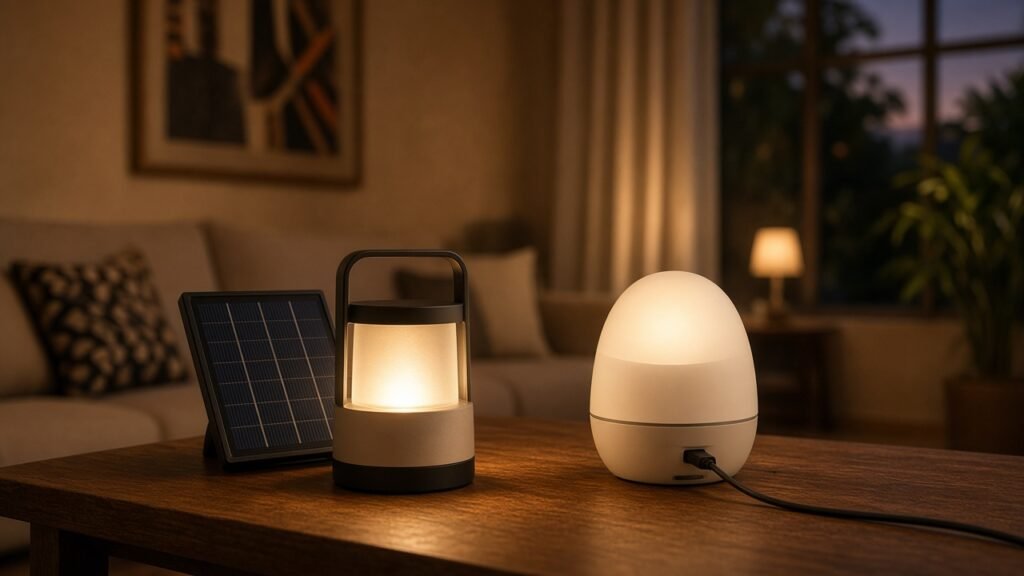
When the grid goes off at night, a good lamp decides whether a household can cook, study and lock up safely, or whether a small shop has to close early. Most buyers end up choosing between two types: a solar lamp that charges from sunlight, and a rechargeable lamp that charges from a socket, power bank or backup system. Neither is better in every home. This guide compares rechargeable vs solar lamps on charging method, runtime and cost of ownership, so you can match the lamp to how power cuts actually happen where you live.
What buyers usually get wrong
Assuming a solar lamp never needs the grid. A solar lamp only refills its battery when its panel gets good daylight. During rainy seasons, in shaded compounds or in flats without a sunny window or balcony, it may not charge fully. Some solar lamps also accept USB charging as a backup, but only rely on that if the listing says so.
Assuming a rechargeable lamp is always ready. A rechargeable lamp needs power to charge. If outages are long or frequent, it can run flat before the grid returns, unless you can top it up from a power bank, inverter or power station.
Trusting runtime claims without context. Runtime figures usually depend on brightness. A lamp may last many hours on its lowest setting and far less on full brightness. Look for the mode the runtime refers to.
Buying on brightness alone. A very bright lamp with a small battery may give you a short burst of light rather than a full evening.
What specs matter most
Whichever type you choose, compare these details on each listing:
- Charging method: solar panel only, mains or USB only, or both. Lamps that offer more than one way to charge give you more options when the weather or the grid lets you down.
- Battery capacity: often shown in mAh or Wh. As a general rule, a larger battery can run longer at the same brightness.
- Runtime and the mode it applies to: check whether the stated hours are for low, medium or high brightness.
- Charging time: how long a full charge takes from the sun or from a socket, as stated by the seller.
- Brightness and modes: lumens, if stated, plus dimming or eco modes that help stretch a charge.
- Panel size and cable (for solar lamps): a separate panel on a cable lets you place the panel in the sun while the lamp stays indoors.
- Extras: some lamps include a USB output to charge a phone. Using it will shorten the lamp’s own runtime.
- Build and weather resistance: a handle or hook, a solid casing and, for outdoor use, any stated water-resistance rating.
How to compare real value
Choose solar if you get reliable daylight, outages are long or unpredictable, or you want lighting that does not depend on the grid at all. Once bought, a solar lamp does not add to your electricity use, which matters if you light several rooms or a shop front every night.
Choose rechargeable if outages are short and predictable, you live in a flat with little direct sun, or you already have a power bank, inverter or power station to top it up. Rechargeable lamps are often more compact and can be charged quickly whenever power is on.
Consider both if your home or shop needs dependable light every night. Many households keep a solar lamp for general lighting and a rechargeable lamp or torch for quick use, so one is usually charged when the other is not.
For cost of ownership, think beyond the price tag. A lamp that holds its charge well, offers useful dimming modes and is built to last can be better value than a cheaper one you replace sooner. Compare what each listing actually states, including battery details, condition and what is in the box.
Recommended product paths on Afriyah
- Solar Lighting: compare solar lamps and lights, then check each listing for charging method, battery and runtime details.
- Power Backup: browse backup power options if you want a way to keep rechargeable lamps and other devices charged during outages.
- Shop all products: search for rechargeable lights, lanterns and home lighting essentials across the catalogue.
FAQs buyers search before purchase
Is a solar lamp or a rechargeable lamp better during power cuts?
It depends on your sunlight and your outage pattern. Solar lamps suit homes with good daylight and long or unpredictable cuts. Rechargeable lamps suit short, regular cuts and homes that can top them up from another power source.
Will a solar lamp charge on a cloudy day?
It may charge, but usually more slowly and not always fully. If you expect several dull days in a row, a lamp that can also charge by USB, or a second rechargeable lamp, gives you a backup.
How can I make a lamp last longer through the night?
Use a lower brightness mode where it is enough, avoid charging your phone from the lamp unless you need to, and start the evening with a full charge.
Can I charge a rechargeable lamp from a power bank or inverter?
Often yes, if the lamp charges by USB or a standard adaptor and your power source has a matching output. Check the lamp’s charging input on the listing and follow the maker’s guidance.
What should I check on the Afriyah product page before checkout?
Confirm the charging method, battery details, stated runtime and the mode it refers to, condition and what is included, and review the shipping and return terms on the live shipping and returns page.
Build your shortlist faster
Note how long your power cuts usually last, how much daylight your home or shop gets, and which rooms need light. Then compare seller-led options on Afriyah with clear specs and pricing, starting with Solar Lighting and the shop, and keep only listings that state their charging method, battery and runtime clearly.