No products in the cart.
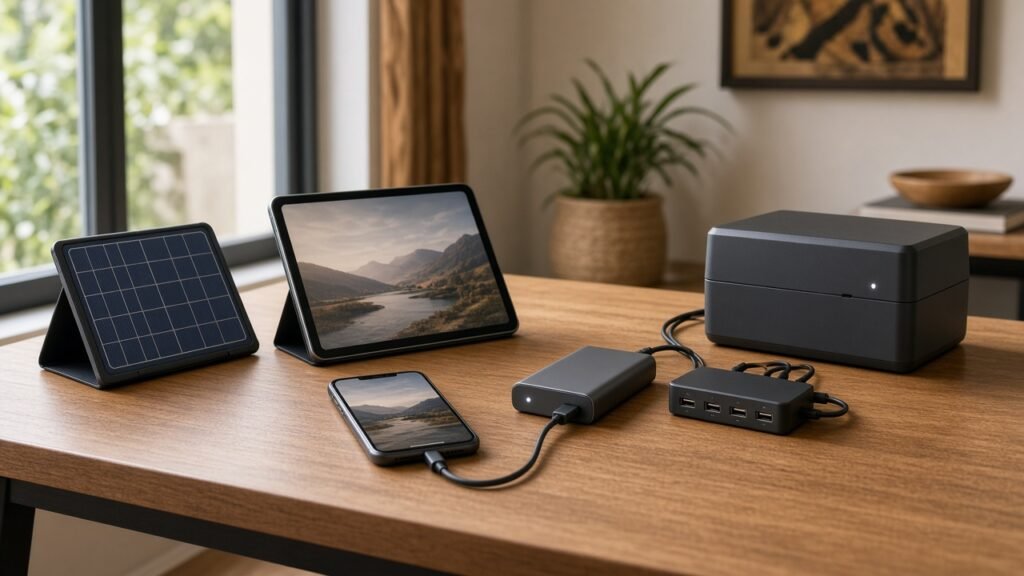
Keeping Phones and Tablets Charged During Outages: A Practical Plan
When the power goes off, a phone is often how families across Africa stay in touch, pay for things and follow the news, and a tablet may be what keeps school work or a small business going. Knowing how to charge phone during power outage periods is less about one perfect gadget and more about a simple plan: a power bank for everyday cover, a way to top it up when the grid is down, and a backup at home for longer cuts. This guide explains how to combine power banks, solar chargers and a UPS so your devices stay usable, and what to check on a listing before you pay.
What buyers usually get wrong
Relying on one device for everything. A single power bank runs flat too. If outages in your area often last more than a day, plan a second way to recharge it, such as a solar phone charger, a car charger or a home backup unit.
Reading the capacity number as usable charge. The milliamp-hour (mAh) figure on a power bank is usually the rated capacity of its internal cells. Some energy is lost in conversion, so the number of full phone charges you actually get is lower than a simple comparison of mAh figures suggests.
Expecting a small solar panel to charge quickly. Folding solar chargers depend on direct sunlight, panel angle and weather. Treat them as a way to slowly refill a power bank during the day, not as a fast charger for a phone you need right now.
Leaving everything until the outage starts. Backup gear only helps if it is charged. Top up power banks and backup units whenever mains power is available.
What specs matter most
Use this checklist when comparing charging gear for outages:
- Power bank capacity: stated in mAh or watt-hours (Wh). Compare it with your phone and tablet battery sizes, remembering that tablets have much larger batteries than phones.
- Output ports and ratings: the number of USB-A and USB-C ports and their stated output in watts or volts and amps. Tablets generally charge better from a higher-output port.
- Input and recharge time: how the power bank itself is charged, and how long the listing says it takes. A slow-to-refill power bank is a weak link when mains power returns only for a few hours.
- Solar charger output: the panel’s stated wattage and USB output. Check whether it has a built-in battery or only charges while the sun is on it.
- USB charging hub: if you plan to charge several devices from one source, check the hub’s total output and per-port ratings, not just the number of ports.
- UPS or power station outputs: whether it has USB ports or only AC sockets, its stated battery capacity, and how it is recharged.
- Protection features: such as overcharge, over-current and short-circuit protection, where the listing describes them.
How to compare real value
Start with your devices. Note the battery size of each phone and tablet in your household and how many of them need to stay charged during a typical outage. That tells you roughly how much stored energy you need.
Then build in layers. A power bank covers the first day. A solar charger or car charger lets you refill it when the grid is down. For long or frequent cuts, a UPS or portable power station at home can charge several devices and run a router or light as well, which is covered in our guide to portable power stations versus inverters.
Compare listings on stated capacity, output ratings, included cables and protection features rather than on headline price alone. A cheaper item that leaves out the cable you need, or charges too slowly for a tablet, may cost more in the end.
For delivery and returns on Afriyah orders, rely on the published shipping and returns policy rather than assumptions.
Recommended product paths on Afriyah
Start with Phone Accessories for chargers, cables and related accessories, and browse Shop all products for tablets, smartphones and charging gear. For larger home backup, see Power Backup for African Homes for UPS units, power stations and inverters.
Afriyah sells its own products alongside listings from third-party sellers, so read each listing’s stated specifications, included accessories and condition, and check that the product images match the version on offer.
FAQs buyers search before purchase
What is the best way to charge a phone during a power outage?
For most households, a charged power bank is the simplest first step. For longer outages, add a way to recharge that power bank without the grid, such as a solar charger or a car charger, or keep a UPS or power station charged at home.
How many times can a power bank charge my phone?
It depends on the power bank’s capacity, your phone’s battery size and conversion losses, so the real number is lower than dividing one mAh figure by the other. Check the listing’s capacity and compare it with your phone’s battery size as a rough guide.
Can a solar charger charge a phone directly?
Many can, in direct sunlight, but output drops in cloud or shade and can stop and start. Many people find it more reliable to use the solar charger to refill a power bank during the day, then charge the phone from the power bank.
Can a UPS charge phones and tablets?
Yes, if it has USB ports or AC sockets you can plug a charger into. Check the listing for its outputs and battery capacity, and remember that a UPS designed mainly for computers may be sized for short runtime rather than all-day charging.
What should I check on the Afriyah product page before checkout?
Confirm the stated capacity, output ports and ratings, input and recharge method, included cables, condition and any protection features, and review the shipping and return terms on the live shipping and returns page.
Build your shortlist faster
List the phones and tablets you need to keep running, how long your outages usually last and whether you have reliable sun or a car available for recharging. Then compare power banks, solar chargers, charging hubs and backup units on Afriyah, starting with Phone Accessories and the shop, and keep only listings that state their capacity and outputs clearly.