No products in the cart.
Starter Solar Kits for Small Homes: What a Complete Kit Should Include
For many small homes across Africa, a starter solar kit for home use is the first step towards lights, phone charging and a fan that keep working through power cuts. The trouble is that “kit” can mean very different things from one listing to the next. Some include everything needed to get running; others leave out the battery, the controller or the cables, and the gap only shows up on installation day. This guide explains what a complete kit should include and how to check a listing before you pay.
What buyers usually get wrong
Assuming “kit” means complete. A solar starter pack may be only a panel and a controller, with the battery sold separately. Read the “what’s in the box” list line by line rather than relying on the main photo.
Buying on panel watts alone. A bigger panel does not help much if the battery is too small to store the energy, or the controller cannot handle the panel’s output. The parts need to be sized to work together.
Forgetting the cables and connectors. Short or thin cables can mean a panel that cannot reach a sunny spot on the roof, or power lost along the way. Check the stated cable length and connector type against where the panel and battery will actually sit.
Expecting a small kit to run everything. A small solar home kit is usually designed for light loads such as LED bulbs, phone charging, a radio or a small fan. Irons, kettles, fridges and air conditioners need a much larger system, so check the listing for what the kit is meant to power.
What specs matter most
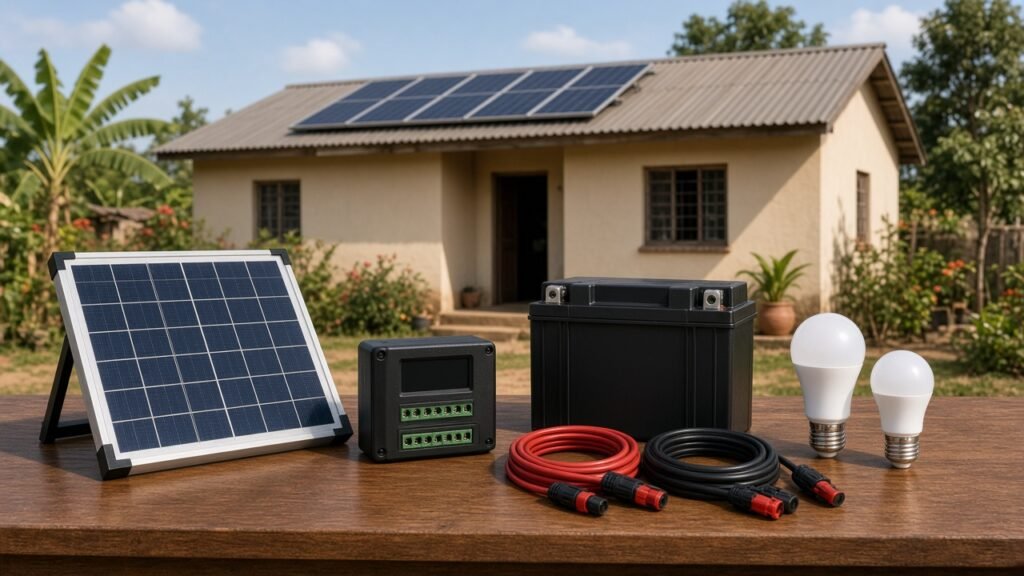
Most complete off-grid kits are built from the same core solar kit components. Use this checklist when reading a listing:
- Solar panel: the stated wattage and voltage, plus how it mounts or stands.
- Charge controller: it regulates charging from the panel to the battery. Check its current rating and that it suits the panel and battery voltage. Some kits build the controller into the battery or power unit.
- Battery or power unit: capacity in amp-hours (Ah) or watt-hours (Wh), voltage, and battery type, such as lead-acid or lithium.
- Inverter, if needed: small kits often supply DC power only, for USB ports and DC bulbs. If you want to run ordinary AC plug-in appliances, the kit needs an inverter, or you will need to buy one that matches the battery.
- Cables and connectors: panel-to-controller and controller-to-battery cables, with stated lengths and connector types.
- Loads and accessories: some kits include LED bulbs, switches or phone-charging leads. Count only what the listing clearly states.
- Protection features: such as overcharge, low-voltage cut-off and short-circuit protection, where the listing describes them.
How to compare real value
Start with what you want to run and for how many hours each evening. Add up the wattage of those items, then compare kits on stated panel wattage, battery capacity and included parts rather than on headline price alone.
A kit that looks cheaper can cost more once you add a missing battery, controller or longer cable. When comparing two listings, put their box contents side by side and price up anything one of them leaves out.
Also think about growth. If you may add another panel or more lights later, check whether the controller and battery have room to expand, and whether the listing mentions any limits.
For delivery and returns on Afriyah orders, rely on the published shipping and returns policy rather than assumptions.
Recommended product paths on Afriyah
Start from Shop all products to browse panels, controllers, cables and solar accessories, and see Power Backup for African Homes for inverters, UPS units and backup-power products. Keep only listings that state their box contents, ratings and battery type clearly, and check that the product images match the version on offer.
Afriyah sells its own products alongside listings from third-party sellers, so read each listing’s stated specifications rather than assuming every kit includes the same parts.
FAQs buyers search before purchase
What should a complete starter solar kit include?
At minimum, a solar panel, a way to regulate charging (a separate charge controller or one built into the power unit), a battery to store energy, and the cables to connect them. Many kits also include LED bulbs or USB charging outputs. An inverter is only included in some kits.
Can a starter solar kit power a fridge or TV?
It depends entirely on the kit’s stated panel wattage, battery capacity and whether it includes an inverter. Small starter kits are usually aimed at lighting and phone charging. Check the listing for the appliances it is rated to power before buying.
Do I need an inverter with my solar kit?
Only if you want to run AC appliances that use a normal wall plug. DC bulbs and USB devices can run directly from many kits. If you add an inverter, make sure it matches the battery voltage.
Can I add more panels later?
Sometimes. The charge controller and battery must be able to handle the extra input. Check the controller’s rating and the manufacturer’s guidance, and ask a qualified installer if you are unsure.
What should I check on the Afriyah product page before checkout?
Confirm the full list of box contents, panel wattage, battery type and capacity, controller rating, cable lengths, condition and any stated protection features, and review the shipping and return terms on the live shipping and returns page.
Build your shortlist faster
Write down what you want to run each evening, measure where the panel and battery will go, and note whether you need AC power or just DC lighting and charging. Then browse panels, controllers, cables and solar accessories on Afriyah in the shop, keeping only listings that state their contents and ratings clearly.