No products in the cart.
How To Buy PV Panels, Controllers & Solar Accessories Without Wasting Money
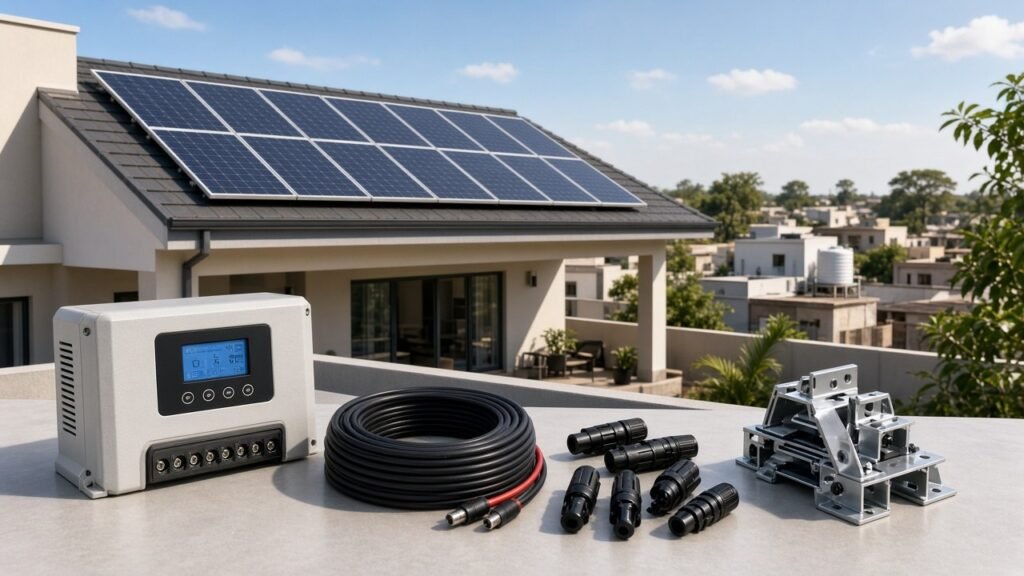
Buying solar panel accessories for home systems is where many African households and small businesses either lock in reliable power or pay twice for mismatches. Panels alone do not make a working system. Controllers, cables, connectors, and mounting parts decide whether energy reaches your batteries and loads safely.
This Afriyah buyer guide stays practical: what usually goes wrong, which specs matter, how to compare value, and where to browse verified catalogue paths on Afriyah Global. We do not invent prices, stock levels, or medical claims. Always confirm the live product page and checkout before you order.
What buyers usually get wrong
- Matching panels to the wrong controller type. PWM and MPPT charge controllers behave differently. Undersizing the controller for your array current is a common failure point.
- Treating cables as an afterthought. Thin or long DC runs waste power as heat and can trip protection. Voltage drop matters more on short, high-current home strings than many first-time buyers expect.
- Mixing connectors and polarity habits. MC4-style connectors only help when they are correctly paired and weather-sealed. Loose or improvised joins are a fire and downtime risk.
- Buying “a panel kit” without a load plan. Lights, routers, TVs, fridges, and shop tools have different surge and continuous needs. Accessories should follow the loads you actually run during outages.
- Ignoring mounting and ventilation. Poor rooftop or wall mounting shortens panel life; controllers and inverters need airflow and dry placement away from rain splash.
What specs matter most
Before you compare offers, write down four numbers from your plan (or from a qualified installer): array voltage range, maximum charge current, battery chemistry/voltage, and the peak watts you need to keep online.
- Charge controller. Check rated PV input voltage, max charging current, battery bank voltage support, and protection features (reverse polarity, over-temperature, short-circuit).
- Solar cables. Prefer outdoor-rated DC cable sized for the current and run length you will actually install. Look for clear cross-section (mm²) and insulation rating on the listing.
- Connectors and protection. Confirm connector type compatibility with your panels, plus fusing or breakers where your installation guide requires them.
- Mounting hardware. Match roof type and wind exposure; loose brackets are not a bargain if panels shift in the rainy season.
- Documentation. Prefer listings that state electrical ratings clearly on the product page. If a critical rating is missing, treat that as incomplete information rather than assuming a value.
How to compare real value
- Start from your use case. Home lighting and Wi‑Fi backup need a different accessory set than a stall fridge or a workshop tool circuit.
- Line up ratings, not adjectives. Compare controller current, PV voltage window, cable section, and included connectors against your plan.
- Count what is included. An accessory bundle that omits the cable or mounts you still need is not cheaper once you fill the gaps.
- Check fulfilment realities. Review live shipping and returns guidance on Afriyah before you commit, especially for cross-border delivery expectations.
- Prefer clear product pages. Specs you can verify beat vague “heavy duty” marketing copy.
Recommended product paths on Afriyah
Use these live catalogue paths to explore panels, controllers, cables, and related solar accessories from vetted Afriyah sellers:
- Power Backup for African Homes — browse backup and solar-adjacent catalogue items with live prices and availability.
- Shop all products — wider discovery when you are still mapping accessories to your full home or small-business kit.
- Shipping & returns — read delivery and return terms before you finalise checkout.
Browse panels, controllers, cables, and solar accessories from vetted Afriyah sellers, then confirm each item’s ratings on its product page.
FAQs buyers search before purchase
Do I need a charge controller if I already have solar panels?
Yes for typical battery-based home systems. The controller regulates charging so batteries are not overcharged or starved. Follow the controller and battery guidance stated on the product pages you choose.
What is the difference between PWM and MPPT controllers?
Both regulate charging. MPPT designs generally extract more energy from a given array in many conditions, while PWM units are often simpler. Choose based on your array voltage, budget, and the ratings published on the listing—not on unverified performance claims.
Which solar cable size should I buy?
Size depends on current and cable length. Use the cross-section and current rating shown on the product page, and follow a competent installation guide for your run. Do not guess a size from a photo alone.
Can I mix accessories from different sellers?
You can, if voltages, connectors, and current ratings are compatible. Mismatched connectors or undersized cables are a common reason systems underperform. When unsure, keep the critical DC path (panel → controller → battery) on clearly rated, compatible parts.
Where should I check shipping and returns on Afriyah?
Use the live shipping and returns policy plus the shipping options shown at checkout for your destination. Policy pages and checkout are the source of truth.
Afriyah Global publishes buyer guides to support informed shopping across African markets. Product availability, pricing, and delivery options are those shown on the live storefront at the time you order.