No products in the cart.
How Many Solar Panels Do You Need? A Simple Sizing Guide
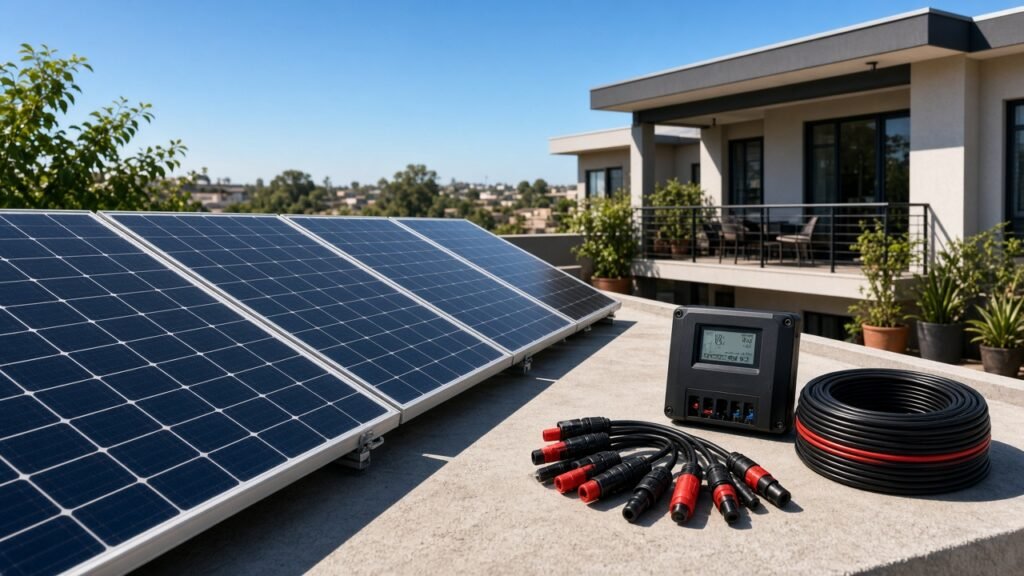
Buying too few solar panels leaves your batteries half-charged by evening; buying too many wastes money that could have gone on storage or a better controller. Across Africa, where many homes lean on solar through grid outages, the honest answer to “how many solar panels do I need” starts with one number: how much energy you use each day. This guide walks through a simple sizing method you can do with a pen and paper before you shop.
What buyers usually get wrong
- Counting panels before counting loads. Panel count follows from your daily energy use, not the other way round. Start with your appliances.
- Confusing watts with watt-hours. A 100 W fridge running for 10 hours uses about 1,000 Wh (1 kWh). Panels are sized against watt-hours per day.
- Assuming full sun all day. Panels only produce close to their rated output for a few “peak sun hours” a day, and that figure changes by location and season.
- Ignoring losses. Heat, dust, cable runs, controllers, batteries and inverters all lose some energy, so real output is lower than the label suggests.
- Forgetting the rest of the system. More panels will not help if the charge controller, cables or battery bank cannot handle them.
What specs matter most
1. Your daily energy use (Wh per day)
List each appliance you want to run on solar, its wattage (from the label or manual) and the hours you use it each day. Multiply watts by hours for each item, then add them up. That total is your daily energy use in watt-hours.
2. Peak sun hours for your location
Peak sun hours describe how much usable sunlight your panels receive in a day. They vary between regions and between rainy and dry seasons, so use a published solar resource tool such as the Global Solar Atlas or PVGIS for your town, and size for your weaker season if you need year-round reliability.
3. A loss allowance
Add a margin for system losses. Many installers add roughly 20–30% on top of the theoretical figure, but ask your installer what applies to your setup.
4. Solar panel wattage
Panels are sold in different power ratings. Higher-wattage panels mean fewer units for the same array size, which matters if roof space is limited. Always check the rated wattage on the listing or datasheet.
The simple sizing formula
Use this three-step estimate:
- Array size (W) = daily energy use (Wh) ÷ peak sun hours
- Adjusted array size (W) = array size × your loss allowance (for example × 1.25)
- Number of panels = adjusted array size ÷ wattage of one panel, rounded up
Worked example (illustrative numbers only): a home using 3,000 Wh a day, in a location with 5 peak sun hours, needs about 600 W of panels before losses. With a 25% allowance that becomes 750 W. Using 400 W panels, 750 ÷ 400 = 1.9, so you would round up to two panels. Using 200 W panels, you would need four. Your own figures will differ, so replace each number with your real loads and local sun data.
How to compare real value
- Match the controller to the array. Check the charge controller’s rated current and maximum input voltage against your panel layout. Our solar cable and connector sizing guide covers the wiring side.
- Size the battery for the night. Panels charge by day; batteries carry the evening and outages. Panel count and battery capacity should be planned together.
- Read the datasheet, not just the headline wattage. Look for rated power, voltage and current figures, dimensions and the warranty terms stated by the seller.
- Plan for growth. If you expect to add a freezer or more fans later, leave room on the roof and headroom in the controller rating.
Recommended product paths on Afriyah
Once you have a target array size, browse the Afriyah shop for panels, controllers, cables and solar accessories, and compare listings on rated wattage and stated specifications. If you also need storage or an inverter, see Power Backup for African Homes. Delivery and return terms are set out on our shipping and returns page.
FAQs buyers search before purchase
How many solar panels do I need to run a house?
It depends on your daily energy use and local sun hours. Add up your appliances’ watt-hours per day, divide by your peak sun hours, add a loss allowance, then divide by the wattage of the panel you plan to buy.
Is it better to buy fewer high-wattage panels or more smaller panels?
Both can reach the same array size. Fewer, higher-wattage panels save roof space and mounting work; smaller panels can suit tight or awkward spaces. Make sure the controller and wiring suit whichever layout you choose.
Do I need more panels for the rainy season?
If you need dependable power all year, size against your weakest season’s sun hours. Otherwise expect lower output on cloudy days and plan backup accordingly.
Can I add more panels later?
Often yes, if your charge controller, inverter and cabling have spare capacity. Check those ratings before buying extra panels.
Build your shortlist faster
Write down your daily watt-hours, your local peak sun hours and your chosen loss allowance, then work out the array size before you open any listing. With that one number, you can browse panels, controllers, cables and solar accessories from vetted Afriyah sellers and keep only the products that fit your system.